
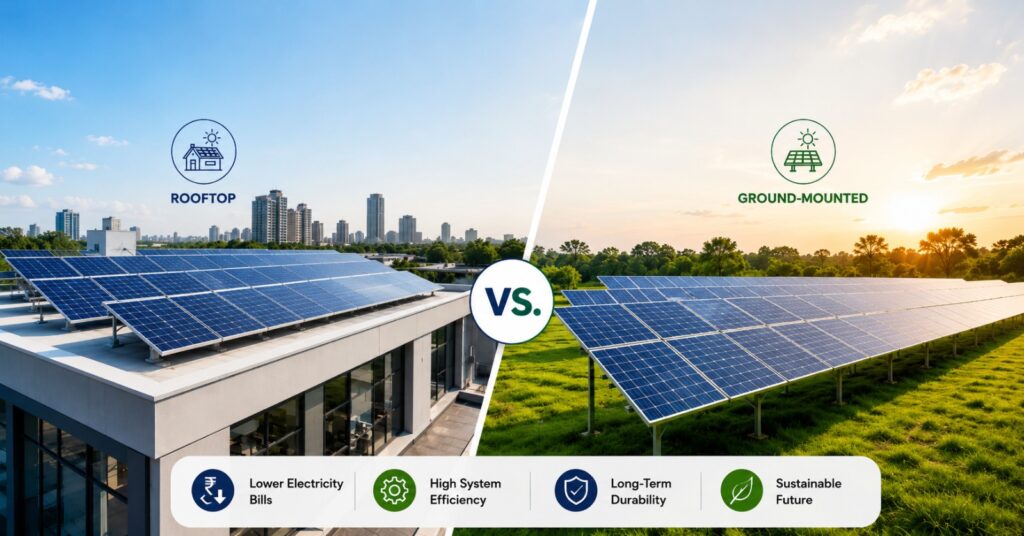
Rooftop vs. Ground-Mounted: Which Solar EPC Solution Is Right for Your Property?
So, you’ve decided to take the leap into renewable energy. It’s an exciting milestone not just for your bottom line, but for operational sustainability. But as you start exploring the technical side of things, you’ll quickly hit a fork in the road: rooftop installation or ground-mounted solar panels?
Choosing the right path isn’t just about aesthetics; it’s about performance, space, and long-term ROI. When you partner with a professional solar EPC firm, they aren’t just installing panels they are architecting an energy system tailored to your specific environment.
Let’s break down the pros and cons of these two common approaches to help you decide which EPC solar strategy fits your property best.
The Case for Rooftop Solar: Maximizing Unused Space
For many property owners, the roof is the most logical place for a solar rooftop system. It’s space that is otherwise serving no purpose, making it an excellent candidate for power generation.
Why choose rooftop?
- Space Efficiency: You don’t need to sacrifice any of your yard or land. You’re essentially turning an existing structure into a power plant.
- Cost-Effectiveness: Because the structure already exists, you save on the capital expenditure associated with building foundations or extensive ground preparation.
- Security: Panels on a roof are naturally harder to tamper with and are less likely to be shaded by new building developments in the future.
The Trade-offs
The biggest limitation is the roof itself. If your roof is old, has a complex shape, or faces the wrong direction, you might face mounting challenges. A quality solar EPC solution will always conduct a structural integrity assessment first. If your roof isn’t up to the task, or if it doesn’t have the surface area to meet your energy goals, rooftop might not be the answer.
The Case for Ground-Mounted Solar: Power and Flexibility
If you have the luxury of open land, ground-mounted solar panels offer a level of flexibility that rooftop systems simply can’t match.
Why choose ground-mounted?
- Optimized Performance: This is the primary advantage. A ground system can be positioned at the perfect angle and orientation to capture maximum sunlight throughout the day.
- Easier Maintenance: Because the panels are closer to the ground, cleaning and servicing them is safer, faster, and more efficient.
- Scalability: If your energy needs grow, it is often much easier to expand a ground-mounted array than it is to squeeze more panels onto a limited roof surface.
The Trade-offs
Ground-mounted arrays require a dedicated footprint. If your property is space-constrained, this might not be an option. Additionally, you’ll need to account for land preparation and soil stability.
Technical Considerations for Your Solar Energy Project
When evaluating an EPC solar partner, look beyond the initial quote and focus on their technical proficiency in three critical areas:
- Load-Bearing and Structural Dynamics: A professional provider must perform a rigorous weight-load analysis for rooftop systems to ensure the building integrity remains uncompromised. Conversely, for ground mounts, they must provide geotechnical reporting to ensure mounting structures can withstand localized wind loads and soil conditions.
- System Efficiency and Degradation Curves: Ask for a technical breakdown of the equipment’s expected output over 25 years. A high-quality solar EPC solution will model the performance based on localized solar irradiance data, accounting for expected power degradation to give you a realistic view of your energy yield.
- Integration and Monitoring Protocols: Modern systems are data-heavy. Your EPC provider should implement real-time monitoring that tracks panel-level performance. This allows for immediate identification of underperforming modules, ensuring your solar energy project maintains peak output throughout its lifecycle.
Making the Final Decision
Ultimately, the right path depends on your property’s specific requirements.
If your priority is utilizing existing infrastructure and preserving your land for other uses, a solar rooftop system is usually the gold standard. If you have the space and want to maximize every kilowatt-hour through perfect orientation, ground-mounted solar panels are likely your best bet.
The beauty of working with a professional is that you don’t have to guess. They will model both scenarios, compare the generation potential, and help you visualize the long-term impact on your electricity costs. Ready to own your energy? The best time to start your solar energy project is today.
So, you’ve decided to take the leap into renewable energy. It’s an exciting milestone not just for your bottom line, but for operational sustainability. But as you start exploring the technical side of things, you’ll quickly hit a fork in the road: rooftop installation or ground-mounted solar panels?
Choosing the right path isn’t just about aesthetics; it’s about performance, space, and long-term ROI. When you partner with a professional solar EPC firm, they aren’t just installing panels they are architecting an energy system tailored to your specific environment.
Let’s break down the pros and cons of these two common approaches to help you decide which EPC solar strategy fits your property best.
The Case for Rooftop Solar: Maximizing Unused Space
For many property owners, the roof is the most logical place for a solar rooftop system. It’s space that is otherwise serving no purpose, making it an excellent candidate for power generation.
Why choose rooftop?
- Space Efficiency: You don’t need to sacrifice any of your yard or land. You’re essentially turning an existing structure into a power plant.
- Cost-Effectiveness: Because the structure already exists, you save on the capital expenditure associated with building foundations or extensive ground preparation.
- Security: Panels on a roof are naturally harder to tamper with and are less likely to be shaded by new building developments in the future.
The Trade-offs
The biggest limitation is the roof itself. If your roof is old, has a complex shape, or faces the wrong direction, you might face mounting challenges. A quality solar EPC solution will always conduct a structural integrity assessment first. If your roof isn’t up to the task, or if it doesn’t have the surface area to meet your energy goals, rooftop might not be the answer.
The Case for Ground-Mounted Solar: Power and Flexibility
If you have the luxury of open land, ground-mounted solar panels offer a level of flexibility that rooftop systems simply can’t match.
Why choose ground-mounted?
- Optimized Performance: This is the primary advantage. A ground system can be positioned at the perfect angle and orientation to capture maximum sunlight throughout the day.
- Easier Maintenance: Because the panels are closer to the ground, cleaning and servicing them is safer, faster, and more efficient.
- Scalability: If your energy needs grow, it is often much easier to expand a ground-mounted array than it is to squeeze more panels onto a limited roof surface.
The Trade-offs
Ground-mounted arrays require a dedicated footprint. If your property is space-constrained, this might not be an option. Additionally, you’ll need to account for land preparation and soil stability.
Technical Considerations for Your Solar Energy Project
When evaluating an EPC solar partner, look beyond the initial quote and focus on their technical proficiency in three critical areas:
- Load-Bearing and Structural Dynamics: A professional provider must perform a rigorous weight-load analysis for rooftop systems to ensure the building integrity remains uncompromised. Conversely, for ground mounts, they must provide geotechnical reporting to ensure mounting structures can withstand localized wind loads and soil conditions.
- System Efficiency and Degradation Curves: Ask for a technical breakdown of the equipment’s expected output over 25 years. A high-quality solar EPC solution will model the performance based on localized solar irradiance data, accounting for expected power degradation to give you a realistic view of your energy yield.
- Integration and Monitoring Protocols: Modern systems are data-heavy. Your EPC provider should implement real-time monitoring that tracks panel-level performance. This allows for immediate identification of underperforming modules, ensuring your solar energy project maintains peak output throughout its lifecycle.
Making the Final Decision
Ultimately, the right path depends on your property’s specific requirements.
If your priority is utilizing existing infrastructure and preserving your land for other uses, a solar rooftop system is usually the gold standard. If you have the space and want to maximize every kilowatt-hour through perfect orientation, ground-mounted solar panels are likely your best bet.
The beauty of working with a professional is that you don’t have to guess. They will model both scenarios, compare the generation potential, and help you visualize the long-term impact on your electricity costs. Ready to own your energy? The best time to start your solar energy project is today.