
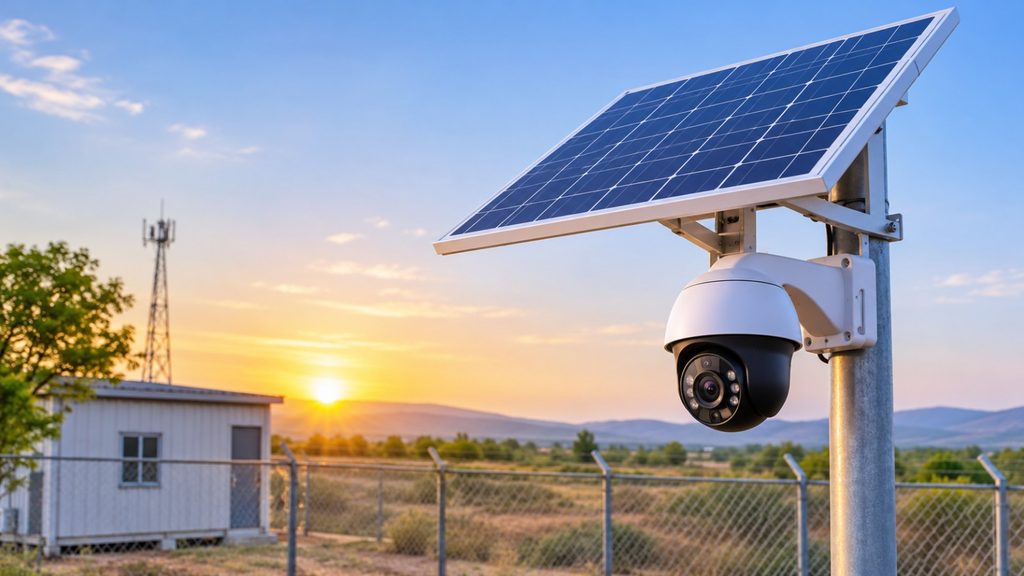
Solar CCTV: The Smart Way to Secure Remote Sites Without Grid Power
Securing a construction site, farm, or highway checkpost is hard when there is no electricity or broadband nearby. Trenching cables and laying power lines costs time and money, and the cameras stay vulnerable if the supply fails. This is where solar CCTV helps. It combines solar charging, battery storage, and cellular connectivity so a camera can run on its own, day and night, wherever you place it.
What Is Solar CCTV?
Solar CCTV is a surveillance setup that runs entirely on solar energy. A solar panel charges a battery during the day, and the battery powers the camera through the night and on cloudy days. A 4G or 5G router sends the footage to the cloud, so you need no wired internet either. If you want to see how this works in practice, Photon Powers offers a complete range of solar CCTV systems in India built for exactly these conditions.
Why Solar Security Cameras Are Gaining Popularity
Interest in solar security cameras has grown quickly across India, for a few clear reasons:
- No grid dependency: The camera works in places where power lines are absent, unreliable, or too expensive to extend.
- Lower running costs: Sunlight is free, so electricity bills for the camera drop to zero.
- Fast installation: There is no trenching or cabling, so a pole-mounted unit can often be up and running quickly.
- Portable and scalable: You can relocate a unit as a project moves, or add more as your site grows.
- Cleaner operation: Solar power cuts fuel and diesel generator use, supporting sustainability goals.
Inside a Solar CCTV Camera
A well-built solar CCTV camera is more than a camera with a panel attached. Quality systems typically include:
- Weather-resistant IP cameras: Bullet or PTZ (pan-tilt-zoom) models with IP66/IP67 protection handle rain, dust, and heat.
- Monocrystalline solar panels: These offer strong efficiency even in limited space.
- LiFePO4 batteries: Known for long life cycles and safe performance, they store energy for the night.
- Smart charge controllers: They manage power flow and protect the battery from overcharging.
- Night vision and AI detection: Infrared lighting captures clear images in the dark, while human and vehicle detection cuts false alarms.
- 4G/5G connectivity: Built-in SIM routers stream video and send instant alerts to your phone.
Solar Powered CCTV Camera vs Traditional CCTV
A conventional system needs a power source, cabling, and a network connection. If the grid goes down, recording often stops, which is exactly when a break-in is most likely. A solar powered CCTV camera avoids this weakness. With properly sized batteries, standalone systems can keep running through several days of low sunlight, so surveillance stays uninterrupted through storms and outages.
The trade-off is upfront cost, since solar hardware costs more than a basic wired camera. But once you factor in the savings on cabling, civil work, and electricity, the total cost of ownership often favours solar, especially at remote locations.
The Role of Wireless CCTV Solutions
Power is only half the problem. The other half is getting video from the camera to you. Wireless CCTV solutions solve this using LTE/5G modems or long-range point-to-point Wi-Fi bridges. With these, you can:
- Watch live video from a mobile app or central control room
- Record footage to the cloud for secure storage
- Control PTZ cameras remotely
- Receive instant motion alerts
When wireless connectivity and solar power are combined, you get a camera that needs neither a wall socket nor a network cable.
Where Solar CCTV Solutions Work Best
Complete solar CCTV solutions suit a wide range of applications:
- Construction sites: Protect machinery, cement, and steel from theft.
- Farms and agriculture: Monitor crops, livestock, and boundaries.
- Highways and roads: Support traffic monitoring and incident detection.
- Industrial and warehouse areas: Secure large yards and storage zones.
- Mining and quarries: Cover vast, remote areas with no infrastructure.
- Solar farms: Safeguard panels, inverters, and substations from vandalism.
- Schools, campuses, and housing societies: Watch entrances, parking areas, and open spaces.
Many setups also add strobe lights, sirens, and two-way audio. A security guard can then warn off an intruder in real time instead of merely reviewing footage later.
How to Choose the Right Solar CCTV System
Before you buy, consider these points:
- Autonomy: Check how many days the battery can run without sunlight.
- Camera quality: Look for high resolution, good night vision, and a suitable lens or PTZ range.
- Durability: Choose weatherproof, corrosion-resistant enclosures and poles.
- Connectivity: Make sure there is reliable 4G/5G coverage at your location.
- Customisation: Panel size, battery capacity, and camera count should match your site.
- After-sales support: Maintenance and service matter as much as the hardware.
Final Thoughts
Remote and off-grid locations no longer have to be security blind spots. With solar security cameras, wireless connectivity, and smart AI features, you can monitor your property around the clock without relying on the grid. Whether you manage a farm, a worksite, or an industrial yard, investing in reliable solar CCTV solutions protects both your assets and your peace of mind.
Ready to secure your site? Explore Photon Powers solar CCTV and get a system designed around your location and budget.